HOMAG INTELLIGENCE interview: Exclusive insights
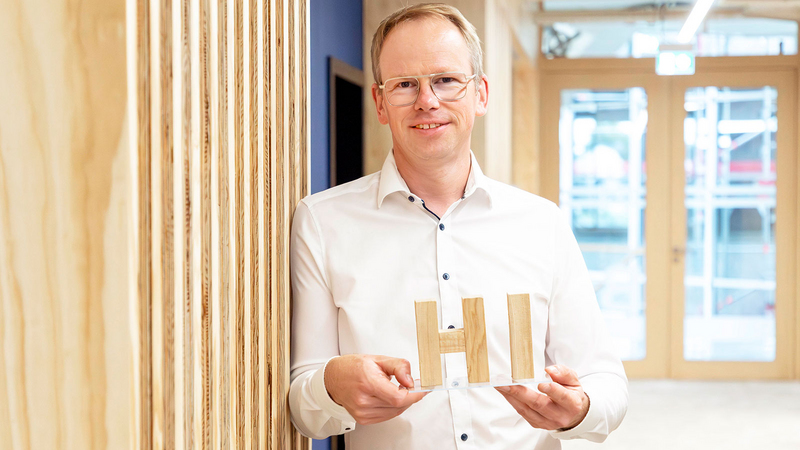
HOB magazine and HOMAG software experts Hendrik Albers and Alexander Lindner
-
![HOMAG INTELLIGENCE is for businesses of all sizes. Each business can personalize their use of the platform, and use the specific digital modules that are most relevant to their business needs.]()
HOMAG INTELLIGENCE is for businesses of all sizes. Each business can personalize their use of the platform, and use the specific digital modules that are most relevant to their business needs. -
![Until now, a furniture producer had to enter and maintain the same data several times in the sales, design and work preparation stages. With HOMAG INTELLIGENCE, everything is maintained centrally. This saves time and reduces the number of errors.]()
Until now, a furniture producer had to enter and maintain the same data several times in the sales, design and work preparation stages. With HOMAG INTELLIGENCE, everything is maintained centrally. This saves time and reduces the number of errors. -
![The innovation HOMAG INTELLIGENCE ensures seamless processes from furniture sales to production.]()
The innovation HOMAG INTELLIGENCE ensures seamless processes from furniture sales to production.
HOB magazine, 11/2025 edition. Read the interview on HOB online.
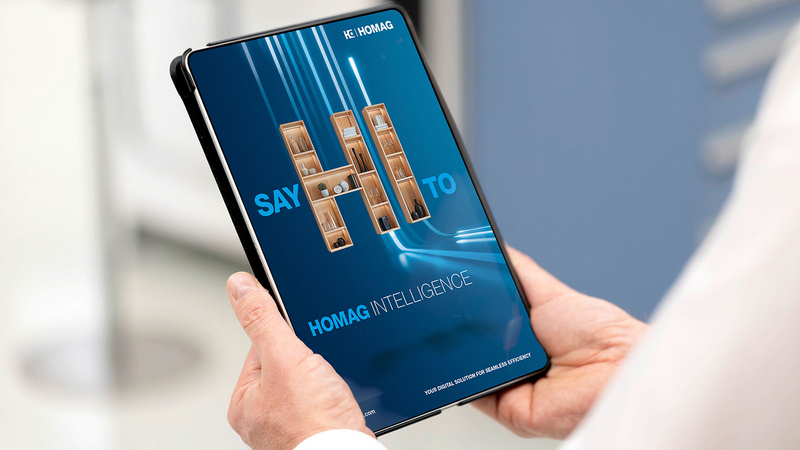
Want to enter data once for instant time savings, prevent errors and work more efficiently? HOMAG INTELLIGENCE digitalizes the entire furniture production process, from sales to manufacturing. Hendrik Albers and Alexander Lindner explain how easy it is to get started with this modular platform.
HOB: Why was HOMAG INTELLIGENCE created?
Hendrik Albers: The platform is the result of several years of development, including collaboration with the Rosenheim Technical University of Applied Sciences. We observed the market, interviewed customers and analyzed trends. We presented our initial ideas of integrated processes for machines and software at LIGNA 2019. This year in Hanover, we added vertical processes to the mix — from sales, configuration and order management, right through production. This approach will enable us to fully implement our digital strategy.
HOB: What specific problems does the platform solve?
Hendrik Albers: HOMAG INTELLIGENCE combines sales, configuration and production into one modular, digital platform. For example, a furniture manufacturer or retailer wants to showcase their products online. Previously, they would have to enter the same data multiple times, for the sales, design and work preparation steps. Now they can manage everything centrally. This saves time and reduces the number of errors.
Alexander Lindner: When it comes to designing furniture, some of the main pinch points our customers have are unnecessary repetition, intensive work processes and unclear sequences. Our solution: design libraries — pre-designed modules that are constantly maintained and updated. Users can also create their own designs. We roll out new furniture trends centrally, without influencing the customer's individual settings in their library.
HOB: How do users work with these libraries?
Hendrik Albers: First of all, they can create designs and products in graphical form and according to rules. This results in error-free results that go directly to production. Secondly, the libraries can be adjusted using default settings, for example for details such as grooved or folded rear walls.
HOB: Who is the platform designed for?
Alexander Lindner: For businesses of all sizes, from woodworking shops to industrial applications. Small businesses can start with one module like intelliDivide, which offers cutting optimization. Larger businesses can use several modules at the same time. They are all using the same platform, just with a lesser or greater scope.
HOB: What else does the user need?
Alexander Lindner: This essentially depends on the type of product. In terms of configuration, we can cover the entire process with the platform. If customers redesign each of their products based on their quote to the end customer, the resulting orders can be loaded into the platform from different systems and processed with production solutions.
HOB: What exactly does this process look like?
Hendrik Albers: Let's take B2B customization as an example: The customer logs into the ordering portal, configures components or uploads a list and places it in the shopping cart. The order goes to the producer, is checked and entered into the ERP. Production is automatically supplied with all the required data: Parts lists, CNC data, edge information, etc. The company can bundle the orders or approve them individually. The parts are processed by the saw, edge processing and CNC one after the other — with full transparency. This means that the customer knows what stage the order is at throughout the entire process.
Alexander Lindner: All of the applications use the same data. And every company can decide where the process starts: With a configurator, with production management or at another point. This modular approach ensures the platform is tailored to the business using it.
HOB: How does central data management work?
Hendrik Albers: Material data, for example, must be available at every step — from sales to production. With HOMAG INTELLIGENCE, it is centrally located in the master data for the material. All systems have access to this master data — including ERP systems, via open interfaces. The same applies to order data.
HOB: How secure is the platform?
Hendrik Albers: The platform is based on software as a service and is run by leading cloud providers with high security standards. In turn, we ensure secure access and regular updates. Companies who maintain and update their own software and hardware bear higher costs and risks.
HOB: How can a company get started?
Alexander Lindner: With a module like intelliDivide cutting and nesting optimization, the user is already accessing the platform. We guide the customer through setup and provide documentation and tutorials. The software is also designed to be user-friendly: Settings are always in the same place so that users can find their way around quickly. For larger projects, we work with the company to find the right solution.
HOB: Do you have any examples of companies already using the platform?
Alexander Lindner: Although the platform was only launched in May, many modules have already been in use for years. One example is productionManager. For configuration and order management, we are currently working with users on solutions, such as for the Cut2Size segment. There was a lot of interest at LIGNA, which is to be expected for a fresh product.
Hendrik Albers: intelliDivide is another example. This cutting optimization program has been around for years. It is now part of HOMAG INTELLIGENCE, as is the material management system behind it.
HOB: What was the feedback like at LIGNA 2025?
Alexander Lindner: Consistently positive — from industrial-scale companies, medium-sized business and woodworking shops alike. Many said that we had our finger firmly on the pulse, as material management and data organization are a major topic for everyone. With the libraries, users can get started immediately.
Hendrik Albers: Admittedly, the subject is complex. But we were able to present it so that it was clear and easy to understand. Visitors were particularly interested in the live demonstrations.
HOB: So what are the next steps?
Hendrik Albers: We are continuously developing our production solutions. To do this, we are bundling our apps and assistants into one package. The first pilot customers are already testing this out, and their feedback will be incorporated into later phases. However, the solution is already ready for use today.
Alexander Lindner: Flexible production control will be an important topic. Using a cloud-based approach allows us to constantly develop new concepts and functions. We also want to build on the close cooperation between partners and manufacturers.
HOB: Does artificial intelligence play a role?
Alexander Lindner: AI needs clean data — which is exactly what our data master provides. Initial AI functions have already been integrated, such as in the optimization process. As this is a cloud-based platform, we will be able to add more applications in the next few years. However, we don't want to focus all of our energy on AI — we just want to use it where it adds value.
Hendrik Albers: For us, AI is a tool, so we need to train it and use it on applications where it makes sense to do so. We have prepared some initial use cases, which we will introduce over the next few years.
HOB: As we are now reaching the end of our interview, do you have anything else to add?
Alexander Lindner: Our machines are naturally also part of the platform. They are able to connect to the platform as soon as they have been delivered — so the customer can benefit from the added value of centralized material and data management. They are therefore part of the overall process.
Hendrik Albers: This also applies to machines from other manufacturers. However, our machines make the process slightly easier thanks to Plug&Play. The design libraries also make it very quick to get started: The user simply has to select the template, edit it — and it's ready to go. This means it's easy to go from configuration to production in next to no time and the investment quickly pays for itself.
This interview was conducted by Jannick Mudersbach (HOB Editor).